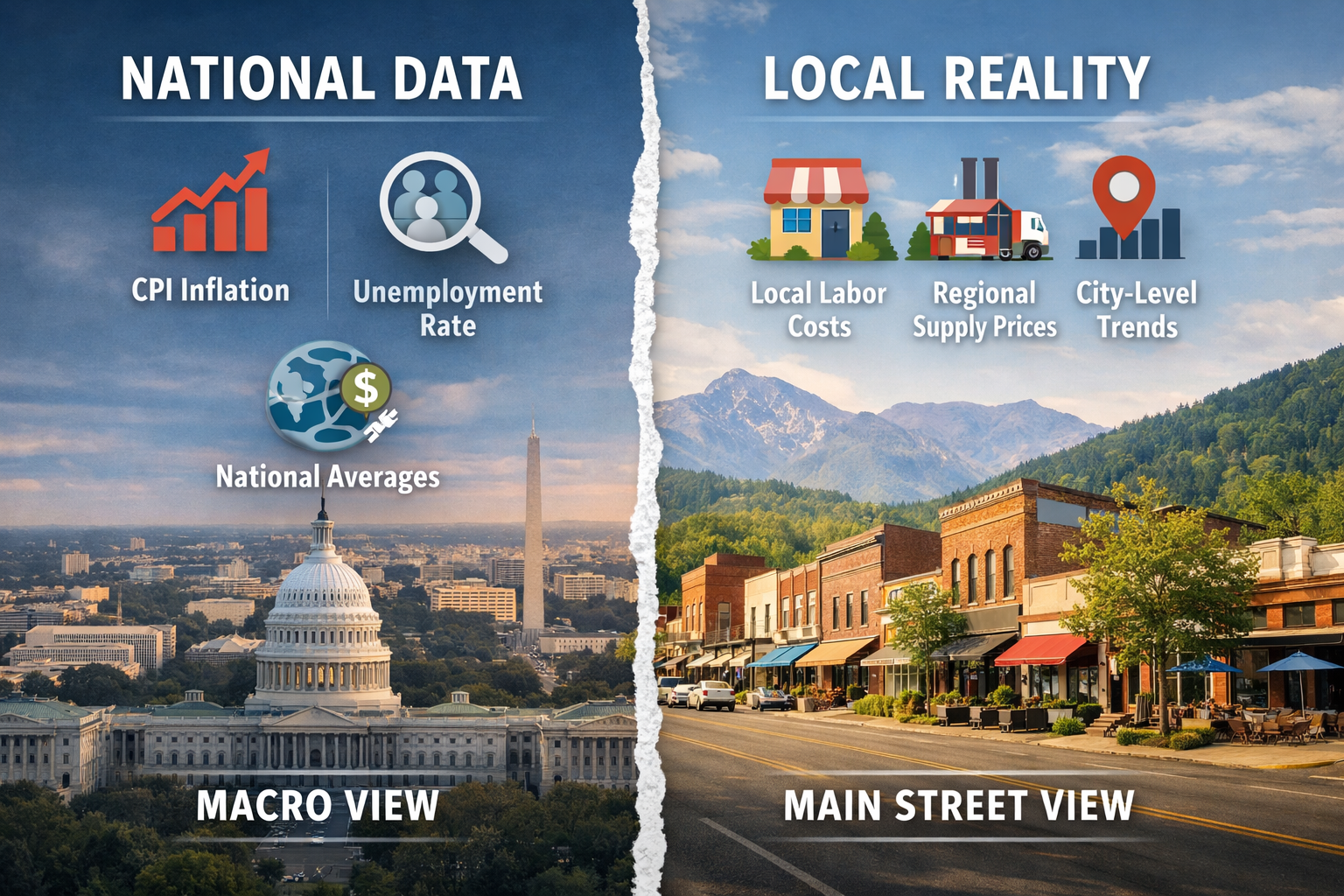
Is it just me or do nation-wide macroeconomic indicators not tell the story of my sweet little hometown.
TL;DR
- Problem: Macroeconomic indicators (think inflation) are not usable by most small businesses
- Microeconomics handles individual behavior but not aggregates (so much, or as easily)
- We need to calculate this and make it available.
Macro & Micro
I want to start with some short definitons. Exhastive - no, debatable - yes, but hey it’s my armchiar.
Macro Economics
Macro economics is the looking at the economy (our system of trade/exchange, of value and goods and services) at a grand large (some would say Macro) scale. The entirity of the US economy or the world. What is going on with money? exchange rates? value of business? Prices? Costs? Imports? Exports? How many people have jobs? How much did businesses produce? questions like that.
In macro economics a single firm is usually whittled away to being of very little impact of the modes of exchange. Most people are price takers.
I would think a majority of our 36 million smb’s (small to midsize businesses) care about price levels and inflation, but the National level is unusable.
The Larger businesses - with a lot data at their disposal - probably calculate any indicators they need anyway. Heck, I hear larger restraunt chains are pricing with time of day (dynamic pricing), and based on your specific characteristics (personalized pricing). Which is stuff, most smaller guys can’t do right now.
Micro Economics
This looks at the behaviour of businesses and individuals in their specific condtion. Profit maximization, cost minimization, decision support systems, cost benefit analysis, etc. This is the stuff I like, I feel that it is a lot more practical. Demand Estimation? Optimal location placement? Game Theroy? Pricing decisions? Oh yeah, micro’s got you covered.
In micro economics your decisions as an individual firm matter. Competition is defined better, and it is very practical. Still something is left wanting… that void is filled by macro economics. Indicators, trends, things of that nature; things that you can estimate at a to get an idea of why things changed.
The Gap
Micro economics “should” Aggregate into macro economics. Macroeconomics “should” disintegrate, break down into (I can’t think of a good antonym for aggregate) microeconomics.
That leaves us with the gap. Macro economic indicators are not usable by a majority of firms because they live in localities, and that’s where a majority of their operations take place. Micro economics fail to show those indicators. You can show the effects, it just can’t show the trends.
The gap is in hyper-local macro economic indicators. We see the use of this because having a nationwide unemployment rate is useful, but it’s more useful to have a state-by-state unemployment rate. For businesses that function in one city and not across multiple cities in a state, a hyper-local unemployment rate, or inflation rate will be very useful.
The Bureau of Labor Statistics calculates local and regional CPI for this very reason.
I live in an agricultural area. Food prices tend to be lower where I am, except for things that are imported from different areas. But living in the Apple Capital of the world where there’s also a lot of cherries grown, cherries and apples tend to be cheaper.
The Solution?
I would really like to see a solution to this problem. I also don’t have enough opportunities to flex my econ skills, so the solution is to calculate on a hyperlocal basis - CPI, PPI, and other macroeconomic indicators. Of course, I’ll have to throw in some microeconomic analysis like demand estimation, supply estimation, and all the good stuff.
The solution: stay curious and answer questions.
What’s next…
Build it!
“If you build it, he will come.” - Field of Dreams, 1989 (it’s not ‘they’, Kevin Costner’s Dad is the one who comes)
Signing off, Best wishes
Gunnar J Newell
Christ is Lord!